

Choosing the right aluminum honeycomb panel is tough. A bad choice leads to costly failures. Here's how to ensure you select a durable, high-quality panel every time.
To choose a high-quality aluminum honeycomb panel, focus on the core's cell size and foil thickness, check the surface sheets for flatness and coating, and verify the adhesive quality. Always ask about the manufacturing process and check for certifications from the supplier.
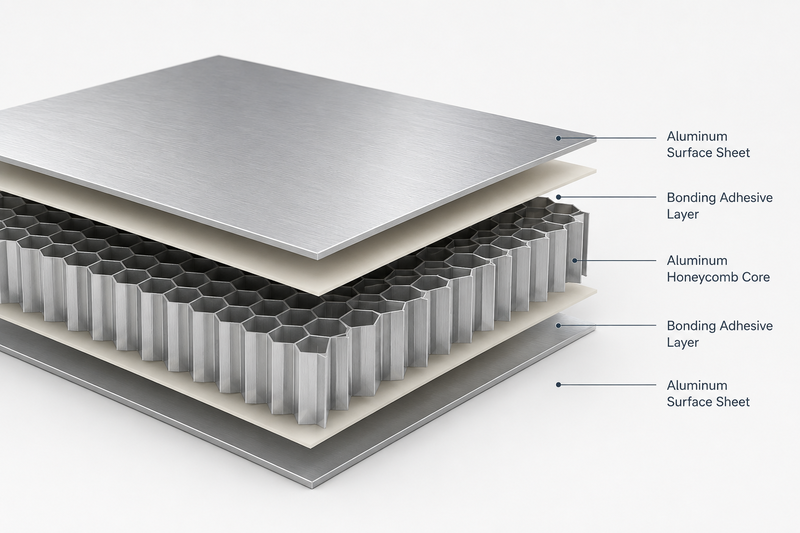
These key points sound simple, but there is more to it. I have seen many clients struggle with panel failures, not realizing the problem started long before the panel was even assembled. Let’s break down what really makes a panel high-quality, starting from the inside out.
What role does the aluminum honeycomb core play in panel quality?
You see the panel's surface, but the hidden core determines its strength. A weak core means the entire panel can fail. The core's quality is the most critical factor1.
The aluminum honeycomb core is the panel's backbone, providing exceptional stiffness and strength at a very low weight. Its cell geometry dictates flatness, and the foil's quality ensures long-term durability and resistance to environmental factors. A better core means a better panel.
I can't tell you how many times a new client has come to us with a delaminated or bent panel from another supplier. In almost every case, the root cause was a poor-quality core. The panel's performance is built upon the honeycomb core, so this is where your inspection should begin. A high-quality panel must have a high-quality core.
Cell Geometry and Uniformity
The first thing to look at is the shape of the honeycomb cells. They should be uniform, clean-cut hexagons. This geometry is naturally strong and distributes forces evenly across the panel. If you see irregular, crushed, or inconsistent cell shapes, it is a huge red flag. Those are weak points where the panel will likely fail under stress. At our company, we manufacture our own honeycomb production equipment. This gives us complete control over the manufacturing process, ensuring every core has perfect, stable cell geometry.
Aluminum Foil Quality and Density
The core is made from aluminum foil. The alloy and thickness of this foil are critical. For most industrial and architectural applications, you will see alloys like 3003 and 5052. The 5052 alloy offers better strength and corrosion resistance2. The thickness of the foil directly impacts the core's compressive and shear strength. A thicker foil creates a stronger, denser core. You need to match the core density to your application.
Here is a simple breakdown:
| Core Property | Low-Density Core | High-Density Core |
|---|---|---|
| Foil Thickness | Thinner (e.g., 0.04mm) | Thicker (e.g., 0.08mm) |
| Cell Size | Larger (e.g., 1/2 inch) | Smaller (e.g., 1/8 inch) |
| Strength | Lower | Higher |
| Weight | Lighter | Heavier |
| Typical Use | Interior partitions, signage | Aerospace, industrial tooling |
How do you check the surface sheets and adhesive?
A panel looks good, but is it? Poor surface sheets or bad adhesive can lead to delamination and ruin your project. You need to know what to look for.
Check surface sheets for consistent thickness, flatness, and a high-quality coating (like PVDF or PE). For the adhesive, ask the manufacturer about the type used (e.g., epoxy, polyurethane) and its bonding strength, temperature resistance, and durability. Visual inspection for bubbles or gaps is also important.
After you confirm the core is good, the next step is to look at the outer layers. The surface sheets, or skins, and the adhesive that binds them to the core are just as important. I once worked with a customer on a large building facade project. The panels they initially sourced looked perfect, but after one summer, the color started to fade and peel. The problem was not the panel structure but a low-grade surface coating that couldn't handle the sun.
Evaluating Surface Sheets
The surface sheets are typically made of aluminum. You need to check three things: the alloy, the thickness, and the coating.
- Alloy: Just like the core, the sheet alloy matters. Common choices include 1100 and 3003 series aluminum.
- Thickness: The sheet thickness adds to the panel's rigidity and impact resistance. A thicker sheet (e.g., 1.0mm) is more durable than a thinner one (e.g., 0.5mm).
- Coating: This is very important for appearance and durability. For outdoor use, you must insist on a PVDF (Polyvinylidene Fluoride) coating. It has excellent resistance to UV radiation, moisture, and temperature changes3. For indoor applications, a PE (Polyester) coating is often sufficient and more economical4. Always check for a smooth, even finish without any specks, scratches, or color variation.
The Importance of the Adhesive Layer
The adhesive is the invisible hero that holds everything together. If the adhesive fails, the panel delaminates, and its structural integrity is gone. You need to ask the supplier what kind of adhesive they use. High-quality panels are typically made with a two-part epoxy or a high-performance polyurethane adhesive film. These create an incredibly strong and durable bond. Avoid suppliers who cannot provide a technical data sheet for their adhesive. When you receive the panels, look along the edges. You should see a clean, solid bond line with no gaps or bubbles.
Why does the manufacturing process matter for panel quality?
Two panels can have the same specs but perform differently. This is often due to the manufacturing process. A shortcut in production leads to long-term problems for you.
The manufacturing process ensures all components are bonded perfectly under controlled temperature and pressure. A high-quality process prevents delamination, ensures panel flatness, and guarantees consistent performance. Ask suppliers about their lamination process and quality control checks.
You can have the best core, sheets, and adhesive, but if they are not assembled correctly, the final panel will be poor. The manufacturing process is where everything comes together. A good manufacturer invests in precise equipment and has strict process controls. A bad manufacturer will take shortcuts to save time and money, and you will be the one who pays the price later.
Press Lamination Technology
The most common method for making panels is press lamination. The core, adhesive, and face sheets are stacked together and put into a large press.
- Hot Press vs. Cold Press: For structural applications, hot pressing is superior. The combination of high heat and uniform pressure activates the thermosetting adhesive, creating a powerful, irreversible bond5. Cold pressing usually relies on contact adhesives and may not provide the same level of long-term durability, especially in demanding environments.
- Uniform Pressure: It is critical that the press applies perfectly even pressure across the entire panel. If the pressure is uneven, some areas will have a weaker bond, creating a risk of delamination.
Quality Control During Production
A reliable manufacturer will have quality control checkpoints throughout the entire process. This isn't just about looking at the final product. It starts with inspecting the raw materials—the aluminum coil for the core, the face sheets, and the adhesive. During production, they should monitor temperature, pressure, and press times. After production, a good supplier will conduct tests on sample panels, such as peel strength tests, to verify the bond quality6. Since we build our own honeycomb machines, we have a unique understanding of how to optimize the entire system for quality. We know exactly what to look for at every stage.
What specifications should you pay attention to?
A spec sheet can be confusing. Focusing on the wrong numbers can lead you to buy an unsuitable product. You need to know which specifications truly matter for performance.
Key specifications are total panel thickness, core cell size, foil thickness, and the type/thickness of the aluminum sheets. Also, check the panel's weight, strength data (compressive and shear strength), and fire rating7. Match these specifications directly to your application's requirements.
Getting the specifications right is about matching the panel to your specific needs. A panel that is perfect for an indoor wall partition will fail if used for an airplane floor. As a buyer, you need to be able to read a technical data sheet and understand what the numbers mean for your project. Do not rely on just one number, like total thickness. You need to look at the complete picture.
Core and Panel Specifications Decoded
When you look at a spec sheet, pay close attention to the details of the core and the overall panel. The details tell the true story of the panel's capabilities.
- Core Cell Size: This is usually given in inches (e.g., 1/4", 3/8"). A smaller cell size means more cells per square area, which results in higher strength and rigidity8.
- Core Foil Thickness: Measured in millimeters (e.g., 0.05mm). Thicker foil makes a stronger, more robust core.
- Panel Thickness: The total thickness of the panel, from one face sheet to the other.
- Face Sheet Thickness: The thickness of the outer aluminum layers.
Matching Specifications to Applications
Different applications require different panel constructions. A good supplier can help you with this, but you should have a basic understanding yourself. Here is a table to give you a general idea of how specifications relate to common uses.
| Specification | Architectural Facade | Interior Partition | Industrial Tooling |
|---|---|---|---|
| Panel Thickness | 15-25mm | 10-15mm | 50mm+ |
| Core Cell Size | 3/8" | 1/2" | 1/4" or 1/8" |
| Foil Thickness | 0.06mm | 0.05mm | 0.08mm+ |
| Face Sheet | 1.0mm w/ PVDF | 0.7mm w/ PE | 2.0mm Mill Finish |
| Key Requirement | Weather Resistance | Lightweight, Flat | Extreme Strength, Rigidity |
Always ask for performance data like compressive strength, shear strength, and peel strength9. These numbers tell you how the panel will behave under load.
How do you evaluate a supplier for a long-term partnership?
Finding a supplier is easy, but finding a reliable partner is hard. A poor supplier creates delays and quality issues. You need a partner who supports your business growth.
Evaluate a supplier on their manufacturing capability, technical expertise, and communication. Ask for certifications (like ISO 900110), case studies, and customer references. A good partner provides engineering support, custom solutions, and a stable supply chain, not just a product.
Choosing a panel is not a one-time purchase; it is the start of a relationship. The right supplier becomes a partner who helps you solve problems and succeed. The wrong supplier can cause production nightmares, project delays, and budget overruns. I have seen both sides, and I can tell you that a reliable partner is one of the most valuable assets a company can have.
Looking Beyond the Product
A great supplier offers more than just a panel. They offer expertise.
- Technical Support: Can they help you select the right specifications for your project? Can they provide design assistance? We often work with our clients' engineering teams to develop custom honeycomb solutions that meet very specific performance targets.
- Customization: Your project might require a non-standard panel size, thickness, or a special cutout. A good supplier has the flexibility and capability to provide custom solutions.
- Communication: Are they responsive? Do they provide clear information and updates? Good communication is essential for a smooth supply chain.
Assessing Manufacturing Capabilities
You need to be confident that your supplier can deliver consistent quality on time.
- Vertical Integration: Ask about their supply chain. A supplier who manufactures their own core, like we do, has far better control over quality, consistency, and lead times11. They are not dependent on another company for the most critical component.
- Certifications: Look for quality management certifications like ISO 9001. This shows they have standardized and reliable processes in place.
- References and Case Studies: Ask for examples of past projects or to speak with current customers. A confident supplier with a good track record will be happy to share this information. A reliable partner is invested in your success.
Conclusion
In conclusion, choosing a high-quality aluminum honeycomb panel means looking beyond the surface. Scrutinize the core, adhesive, and manufacturing process to ensure lasting performance for your project.
"Nondestructive Inspection and Quantification of Select Interface ...", https://pmc.ncbi.nlm.nih.gov/articles/PMC11173902/. Structural analyses of sandwich panel failure modes, as reviewed in composite structures literature, consistently identify core shear failure and core-to-facesheet debonding as dominant failure mechanisms, supporting the article's emphasis on core quality as a primary performance determinant. Evidence role: case_reference; source type: paper. Supports: Core integrity is a primary determinant of overall sandwich panel structural performance and failure behavior. Scope note: Describing the core as the single 'most critical' factor is a relative judgment; adhesive bond quality and facesheet integrity are interdependent contributors to panel performance, and their relative importance varies with loading conditions and application. ↩
"What's The Difference Between 3003 Aluminum & 5052? - Kloeckner", https://www.kloecknermetals.com/blog/whats-the-difference-between-5052-3003-aluminum/. According to the Aluminum Association and materials engineering references, 5052 aluminum exhibits higher tensile strength and superior corrosion resistance compared to 3003, owing to its magnesium content, making it preferable in structurally demanding or corrosive environments. Evidence role: definition; source type: institution. Supports: The mechanical and corrosion-resistance properties of aluminum alloy 5052 relative to 3003. Scope note: Published alloy property tables reflect standardized test conditions and may not directly replicate performance within a bonded honeycomb core assembly. ↩
"PVDF coating for aluminium cladding: the ultimate guide", https://www.kgecoating.com/pvdf-coating-for-aluminium-cladding-the-ultimate-guide/. The American Architectural Manufacturers Association standard AAMA 2605 specifies minimum performance requirements for PVDF-based coatings on architectural aluminum, including criteria for chalk resistance, color retention, and adhesion after accelerated weathering, supporting claims of superior outdoor durability. Evidence role: expert_consensus; source type: institution. Supports: PVDF coatings meet recognized performance standards for UV, moisture, and thermal resistance on architectural aluminum. Scope note: AAMA 2605 defines minimum thresholds rather than absolute performance ceilings; actual service life depends on coating thickness, application quality, and environmental exposure levels. ↩
"FGIA/AAMA 2603 - PPG", https://www.ppg.com/en-US/industrialcoatings/fgia-aama-2603. AAMA 2603 establishes minimum performance requirements for organic coatings on architectural aluminum intended primarily for interior or low-exposure applications, providing a standards basis for the article's claim that PE coatings are adequate for indoor use. Evidence role: general_support; source type: institution. Supports: Polyester coatings meet recognized performance standards for interior architectural aluminum applications. Scope note: AAMA 2603 does not address cost comparisons; relative pricing between PE and PVDF coatings varies by supplier, application method, and market conditions. ↩
"[PDF] Experimental validation of co-cure process of honeycomb sandwich ...", https://sites.usc.edu/composites/files/2022/06/Experimental-validation-D-Zebrine.pdf. Research on sandwich panel fabrication indicates that thermosetting adhesives cured under controlled heat and pressure achieve higher cross-link density and peel strength compared to contact-adhesive cold-bonding methods, consistent with the article's claim of superior hot-press bond durability. Evidence role: mechanism; source type: paper. Supports: Elevated temperature and pressure during lamination improve adhesive cure completeness and resulting bond strength in sandwich panel construction. Scope note: Comparative performance is adhesive-formulation-specific; some advanced cold-cure systems may approach hot-press performance under optimal conditions. ↩
"Determination of Flatwise Tensile Strength of Various Honeycomb ...", https://ntrl.ntis.gov/NTRL/dashboard/searchResults/titleDetail/N7720171.xhtml. ASTM standards including ASTM C363 (node tensile strength) and ASTM D1781 (climbing drum peel) provide standardized methodologies for quantifying bond integrity in honeycomb sandwich constructions, supporting the article's reference to peel strength testing as a quality verification tool. Evidence role: definition; source type: institution. Supports: Standardized peel and flatwise tensile tests exist for evaluating adhesive bond quality in honeycomb sandwich panels. Scope note: The article does not specify which standard is applied; different test methods yield non-comparable numerical results, so the specific protocol used by a given manufacturer should be confirmed. ↩
"The 2026 Guide to Aluminum Composite Metal Panel System ...", https://aluwedo.com/2026-aluminum-composite-metal-panel-system-standards-performance/. ASTM E84 (surface burning characteristics) and EN 13501-1 (European reaction-to-fire classification) are widely referenced standards for evaluating and classifying the fire performance of building panels including aluminum composite and honeycomb products, providing the regulatory context for the article's recommendation to check fire ratings. Evidence role: historical_context; source type: government. Supports: Recognized fire performance standards exist for classifying aluminum cladding and panel products used in construction. Scope note: Applicable standards vary by jurisdiction and end-use application; buyers should confirm which specific standard is required by local building codes for their project. ↩
"[PDF] Strength evaluation of honeycomb FRP sandwich panels with ...", https://researchrepository.wvu.edu/context/etd/article/3630/viewcontent/7164_3635_Chen_An_dissertation.pdf. Classical honeycomb mechanics models, as described in Gibson and Ashby's work on cellular solids, demonstrate that core compressive and shear stiffness scale inversely with cell size when foil thickness is held constant, supporting the article's assertion that smaller cells yield higher strength and rigidity. Evidence role: mechanism; source type: paper. Supports: Reducing honeycomb cell size increases core compressive and shear strength for a given foil thickness and alloy. Scope note: The relationship is derived from idealized hexagonal geometry models; manufacturing imperfections and adhesive bond quality introduce deviations from theoretical predictions. ↩
"[PDF] Performance of Sandwich Panels in FPL Experimental Unit", https://www.fpl.fs.usda.gov/documnts/fplrp/fplrp12.pdf. ASTM standards C365 (flatwise compressive strength), C273 (shear properties), and D1781 (peel strength) collectively define the primary mechanical performance metrics for honeycomb core sandwich panels, corroborating the article's identification of these three properties as key specification criteria. Evidence role: expert_consensus; source type: institution. Supports: Compressive, shear, and peel strength are standard mechanical characterization metrics for honeycomb sandwich panels. Scope note: Additional metrics such as flexural stiffness, impact resistance, and fatigue performance may be equally critical depending on the application but are not addressed in the article. ↩
"4.3 Determining the Scope of the Quality Management System [ISO ...", https://www.iso-9001-checklist.co.uk/4.3-how-to-write-your-scope-for-iso-9001-with-7-examples.htm. ISO 9001:2015, published by the International Organization for Standardization, specifies requirements for a quality management system in which an organization must demonstrate consistent process control, risk-based thinking, and customer-focused continual improvement, providing a basis for the article's claim that certification signals standardized manufacturing practices. Evidence role: definition; source type: institution. Supports: ISO 9001 certification requires documented quality management processes, including process control, product monitoring, and continual improvement. Scope note: ISO 9001 certifies the presence of a quality management system rather than guaranteeing specific product performance outcomes; compliance audits vary in rigor across certification bodies. ↩
"What is vertical integration in companies? – Beyond Esade", https://www.esade.edu/beyond/en/vertical-integration-companies/. Operations management literature on vertical integration, including work published in journals such as the Journal of Operations Management, identifies reduced supplier dependency, tighter process monitoring, and shorter lead times as potential advantages of in-house component production, providing general support for the article's claim about core self-manufacture. Evidence role: general_support; source type: paper. Supports: Vertical integration in manufacturing can improve quality control and supply chain reliability by reducing dependence on external suppliers. Scope note: Empirical outcomes of vertical integration vary significantly by industry, firm size, and process complexity; the claim as applied specifically to honeycomb core manufacturing is not directly tested in the general supply chain literature. ↩
Leave a Reply